Toolkit
Free Chemistry Calculators and STEM Tools for Students
The Online Toolkit is a suite of free scientific calculators, tools and reference materials for students, scientists, researchers, and educators, which can be used to solve a variety of common problems in organic, inorganic, analytical and physical chemistry, thermodynamics, engineering, physics and more. Our tools are forever free, and will never require sign-ups or paywalls to access.
Reference Materials
Explore scientific data for physical scientists
Inorganic Chemistry Tools
Investigate metal complexes and crystal fields
Stoichiometry Calculators
Explore the standardized reaction units for reactants and products
Mole Calculator
Convert between mass and moles, with searchable molar masses by element names or symbols.
Molarity & Dilution
Calculate solution concentrations and solve dilution equations (C₁V₁ = C₂V₂).
Molality Calculator
Determine molal concentrations based on solute moles or mass, and solvent masses.
Empirical Formula
Find empirical and molecular formulas from elemental percentage composition or mass data.
Limiting Reagent Calculator
Determine the limiting reagent and theoretical yield in chemical reactions.
Chemical Kinetics
Investigate the speeds of chemical reactions
Electrochemistry
Calculate cell potentials
Materials Science
Explore crystal structures
Acid/Base Calculators
Investigate acidity and alkalinity of solutions
Gas and Pressure Calculators
Explore the behavior of gaseous substances
Nuclear
Calculate radioactive decay
Thermodynamics Tools
Explore the science of energy
Optics
Investigate visible light
Converters
Interconvert different units
Non-Tools
STEM articles, external resources and our privacy policy
Essential Chemistry Calculators for Students and Researchers
The Online Toolkit has free chemistry calculators for stoichiometry problems, pH and buffers, thermodynamics and much, much more, as well as calculators for materials science and physics. Our tools cover a great range of undergraduate and postgraduate chemistry, from mole calculations and limiting reagents to Arrhenius kinetics, Raoult's Law, and crystal field theory. In addition, we're constantly expanding the site to include more and more functionality. If you have any ideas for additions, let us know using the button in the footer! All calculators are free, require no sign-up, and are built to work on all desktops, as well as mobile devices.
Tool Showcase
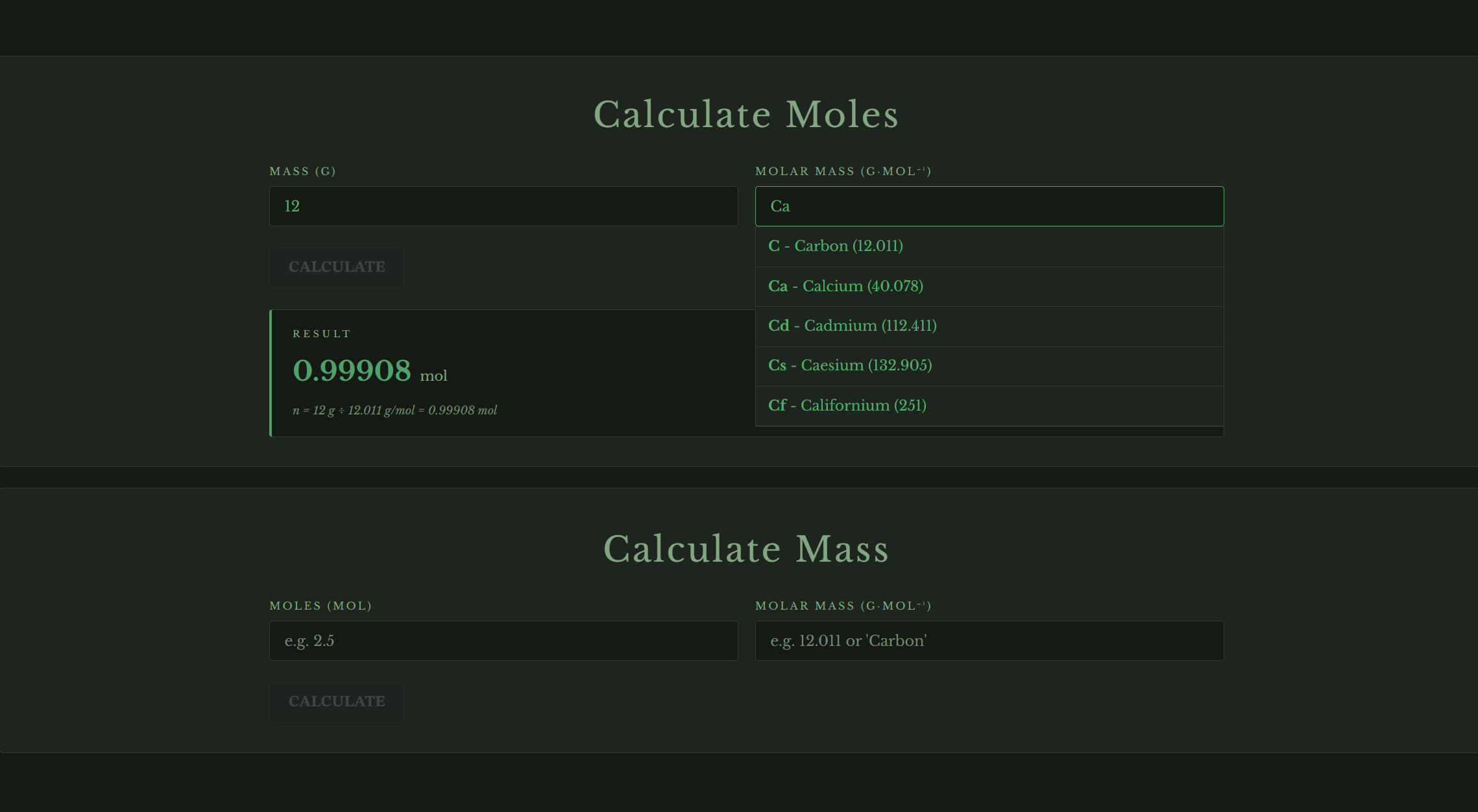
Mole Calculator
Our free online mole calculator lets you instantly convert between masses and moles for any element or compound, with searchable molar masses.
Simply enter a chemical formula or element name and mass to get the molar quantity for stoichiometry problems or lab prep.
Go to tool →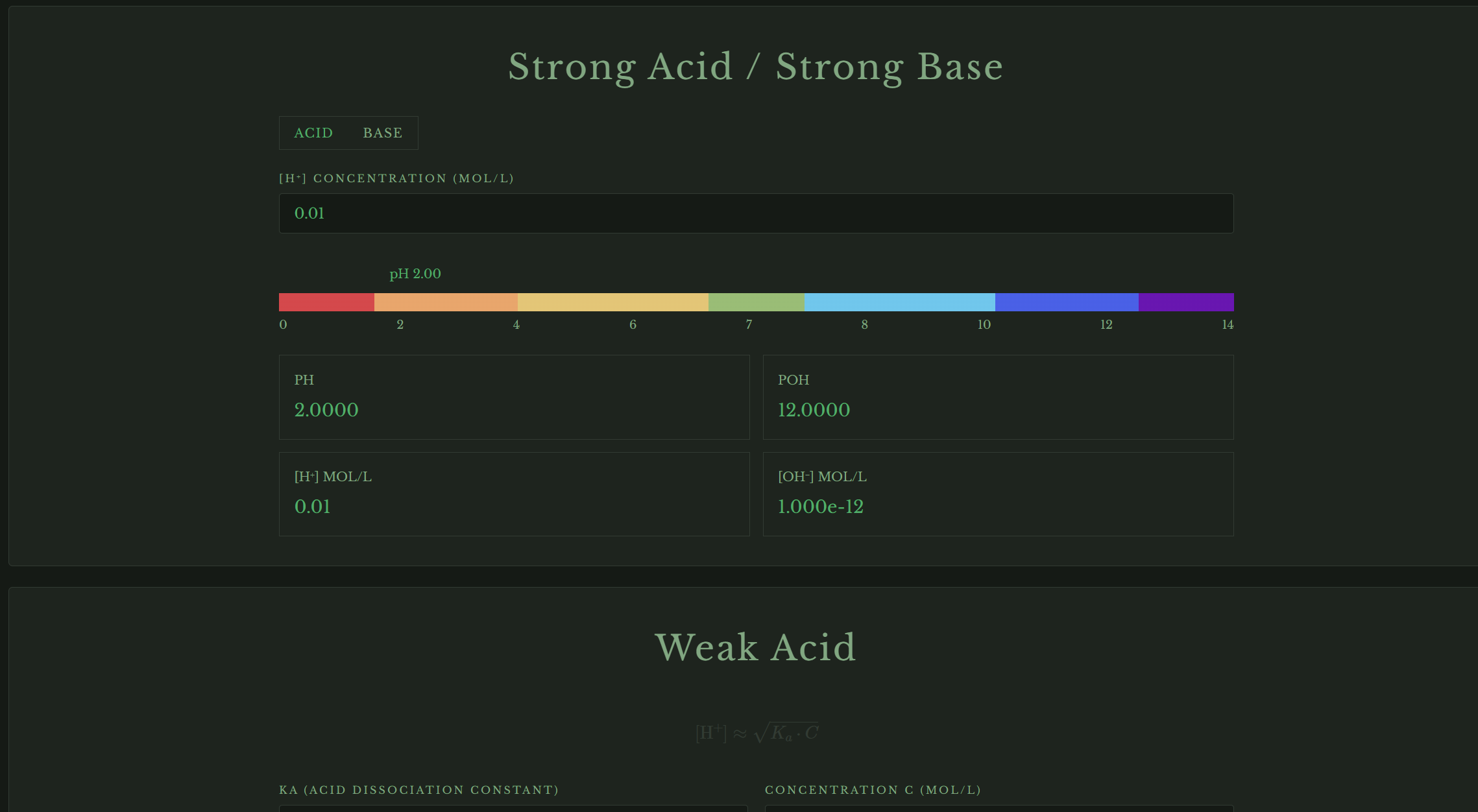
pH Calculator
Calculate pH, pOH, hydrogen ion concentration [H⁺] and hydroxide ion concentration [OH⁻] for strong acids, weak acids, strong bases, weak bases, and buffer solutions.
Visualize pH on a display, and compute from acid or base concentrations. Includes calculators with Ka and Kb values for weak acids, and Henderson-Hasselbalch calculations for buffer solutions.
Go to tool →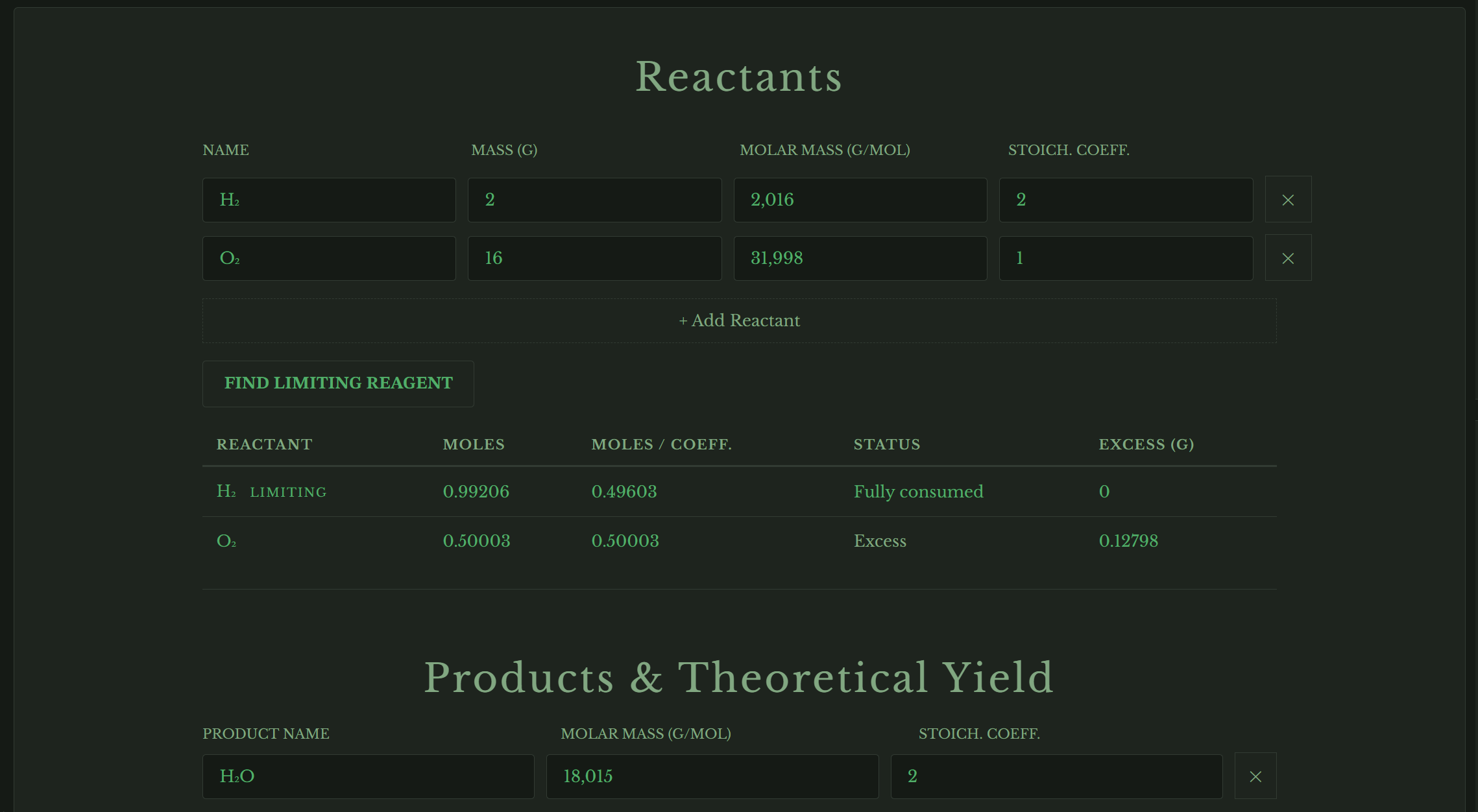
Limiting Reagent Calculator
Determine the limiting reagent, excess reagent, and theoretical yield for any chemical reaction.
Enter your reactants, their molar masses, and available quantities to instantly find which reagent runs out first and how much product can be formed. Useful for stoichiometry, lab planning, and yield calculations across all areas of synthesis.
Go to tool →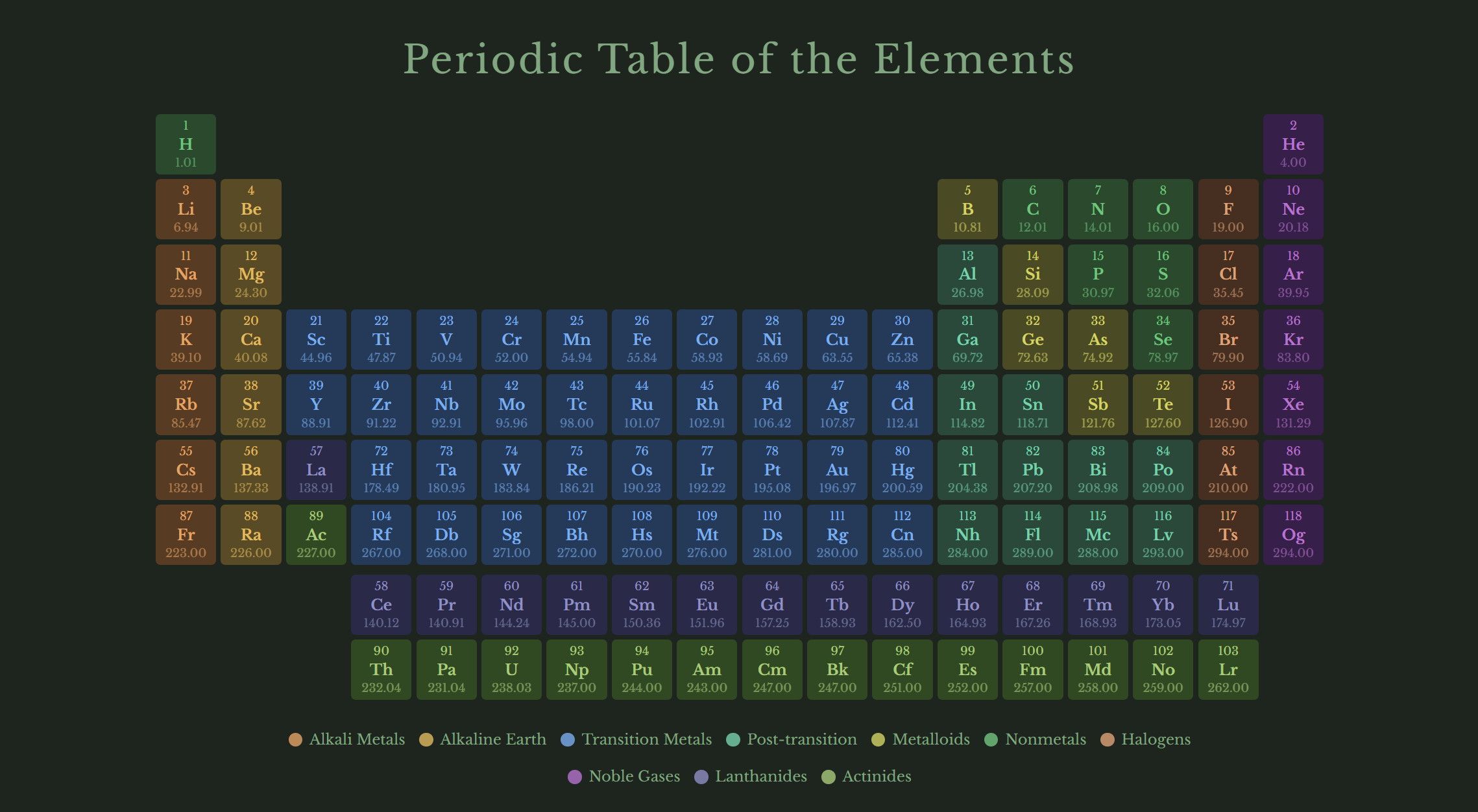
Periodic Table
An interactive periodic table of elements with detailed data for all 118 elements.
Includes atomic number, atomic mass, electron configuration, electronegativity, melting and boiling points, phase at STP and elemental category.
Ideal for anyone studying atomic structure or elemental properties.
Go to tool →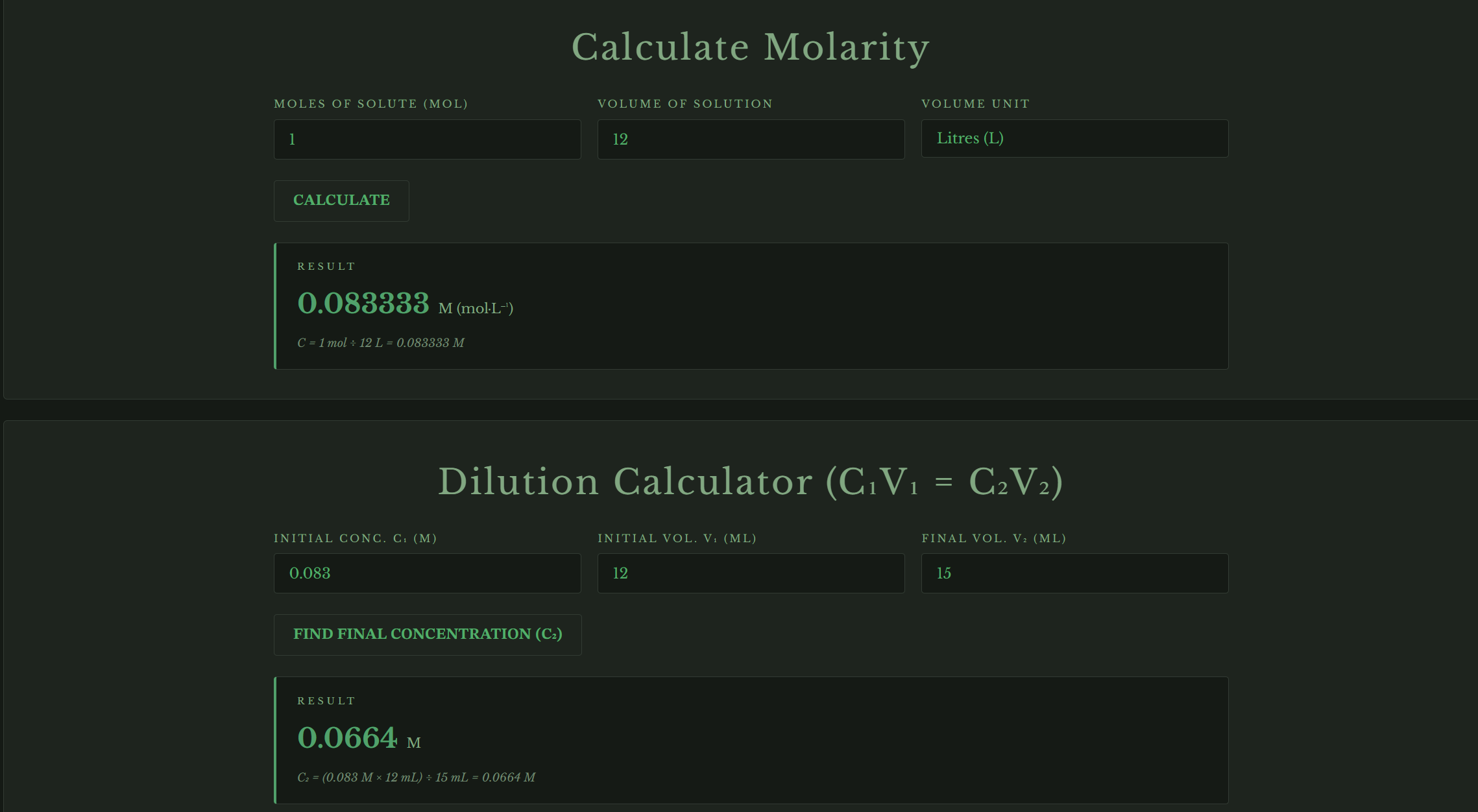
Molarity & Dilution Calculator
Calculate solution concentrations in mol/L and solve dilution equations using C₁V₁ = C₂V₂, across all common concentration units.
Perfect for preparing solutions in analytical chemistry, biochemistry, and general laboratory work, where instant concentration calculations are needed.
Go to tool →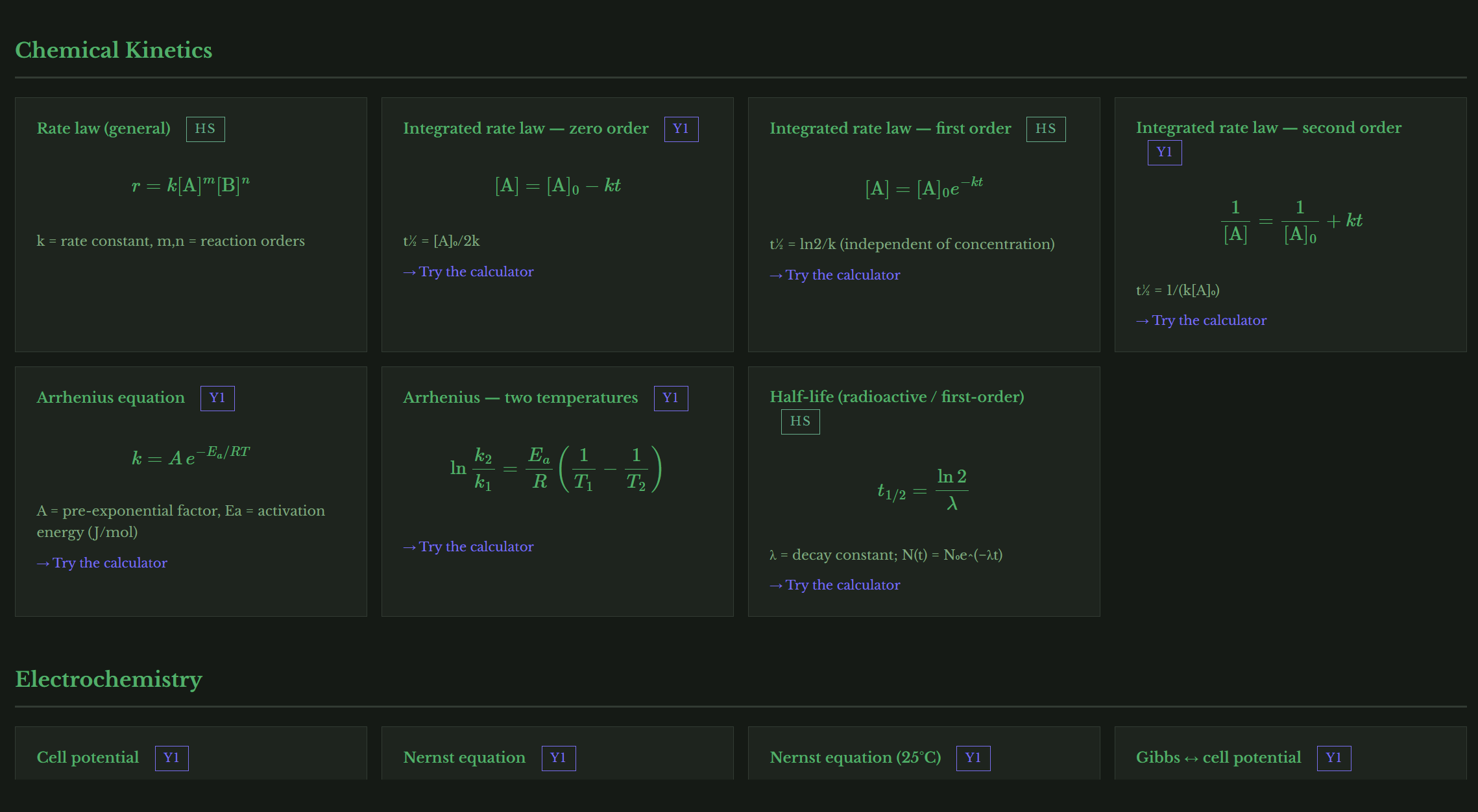
Chemistry Formula Sheet
A comprehensive, searchable formula reference covering thermodynamics, kinetics, electrochemistry, materials science, gases, and more.
Each formula is expandable, and many link to related tools, allowing one to test the relationships the equation defines.
Designed for chemistry students and scientists as a central reference tool for chemistry equations.
Go to tool →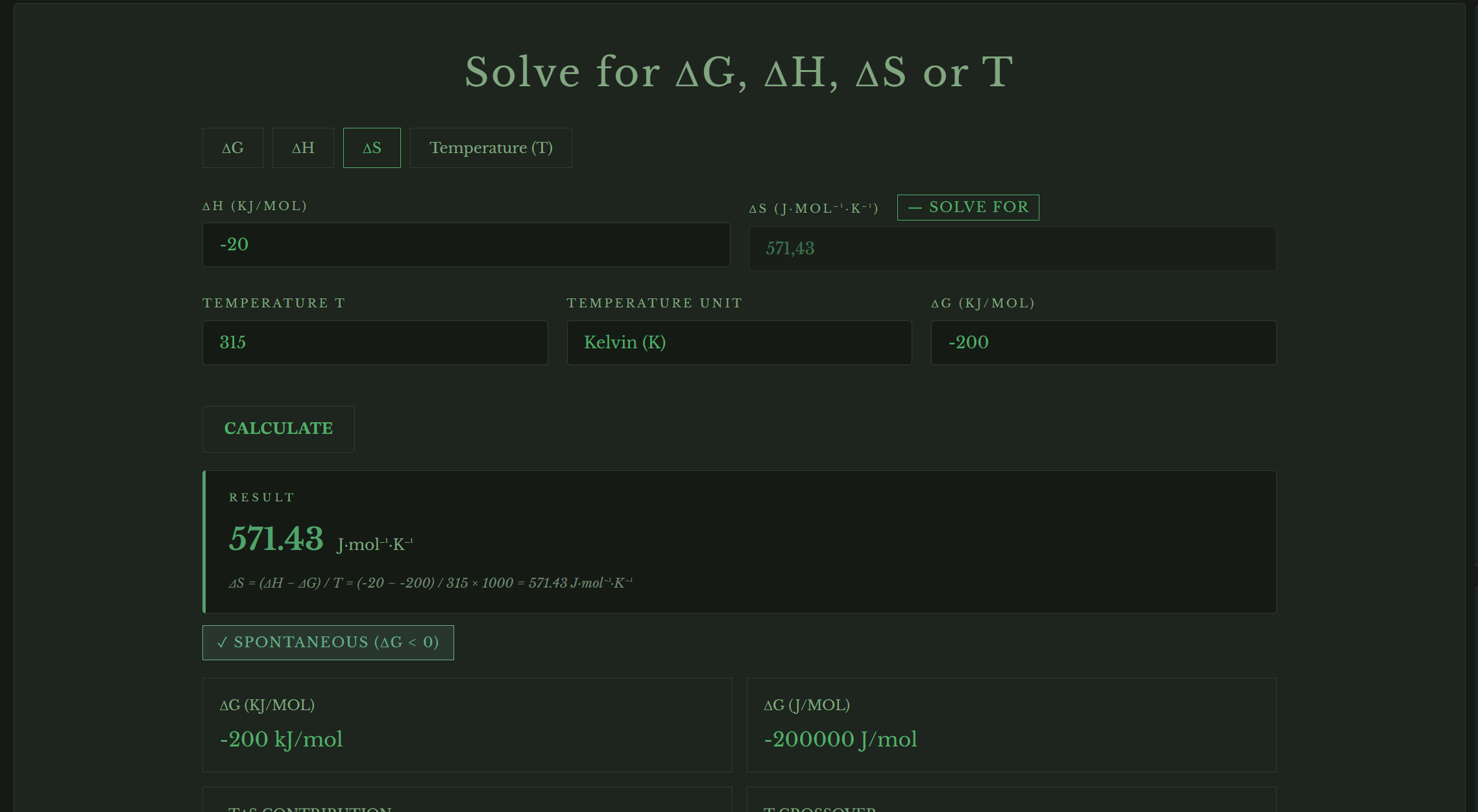
Gibbs Free Energy Calculator
Solve for Gibbs free energy change ΔG, enthalpy change ΔH, temperature or entropy change ΔS using the fundamental thermodynamic relation ΔG = ΔH − TΔS.
Instantly determine whether a reaction is spontaneous, non-spontaneous, or at equilibrium. Essential for physical chemistry, biochemistry, and chemical engineering thermodynamics problems.
Go to tool →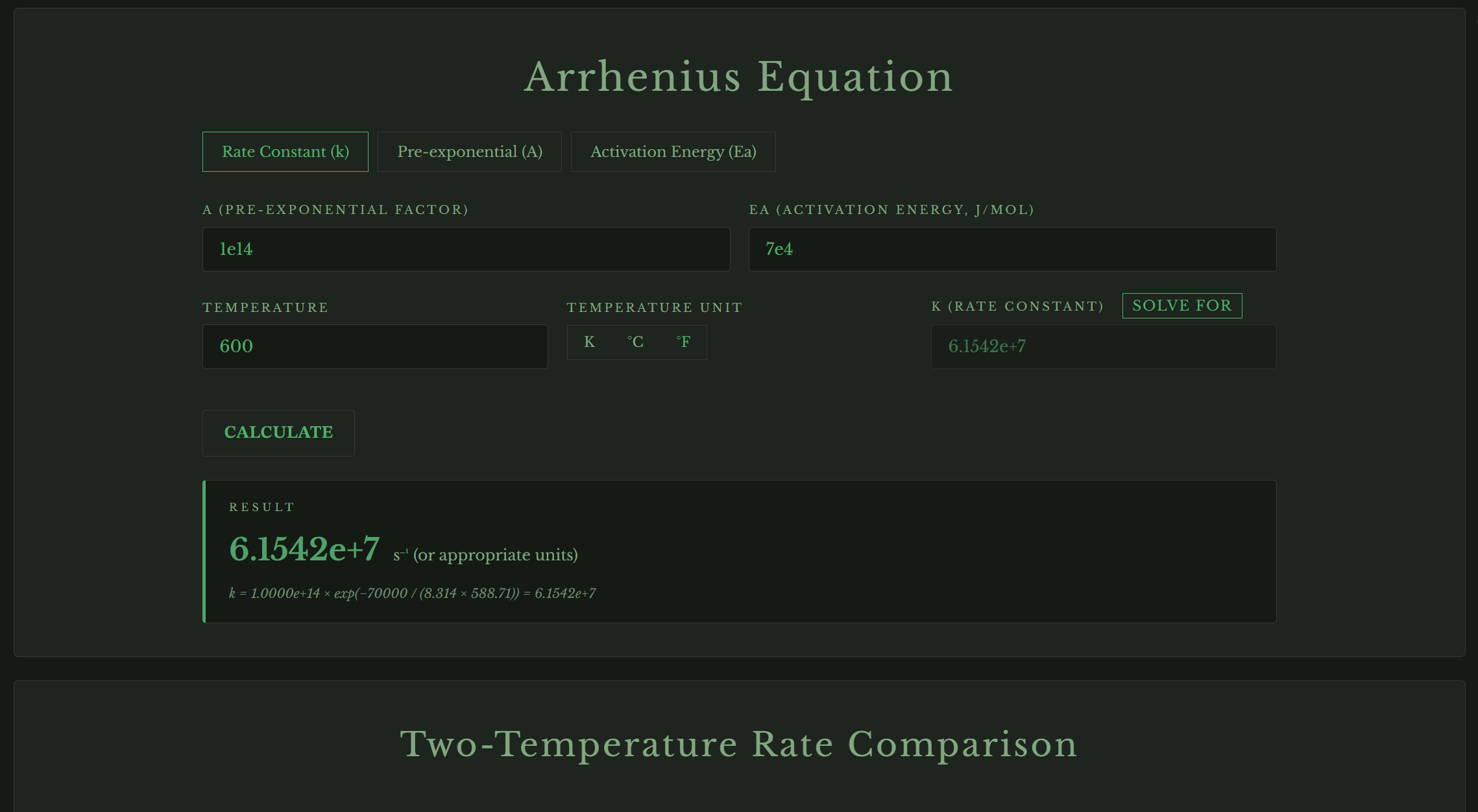
Arrhenius Calculator
Solve the Arrhenius equation for rate constant k, activation energy Ea, or pre-exponential factor A.
Compare reaction rates at two different temperatures and explore how temperature dependence affects reaction kinetics.
Used widely in physical chemistry, chemical engineering, and materials science to model temperature-dependent rate behaviour.
Go to tool →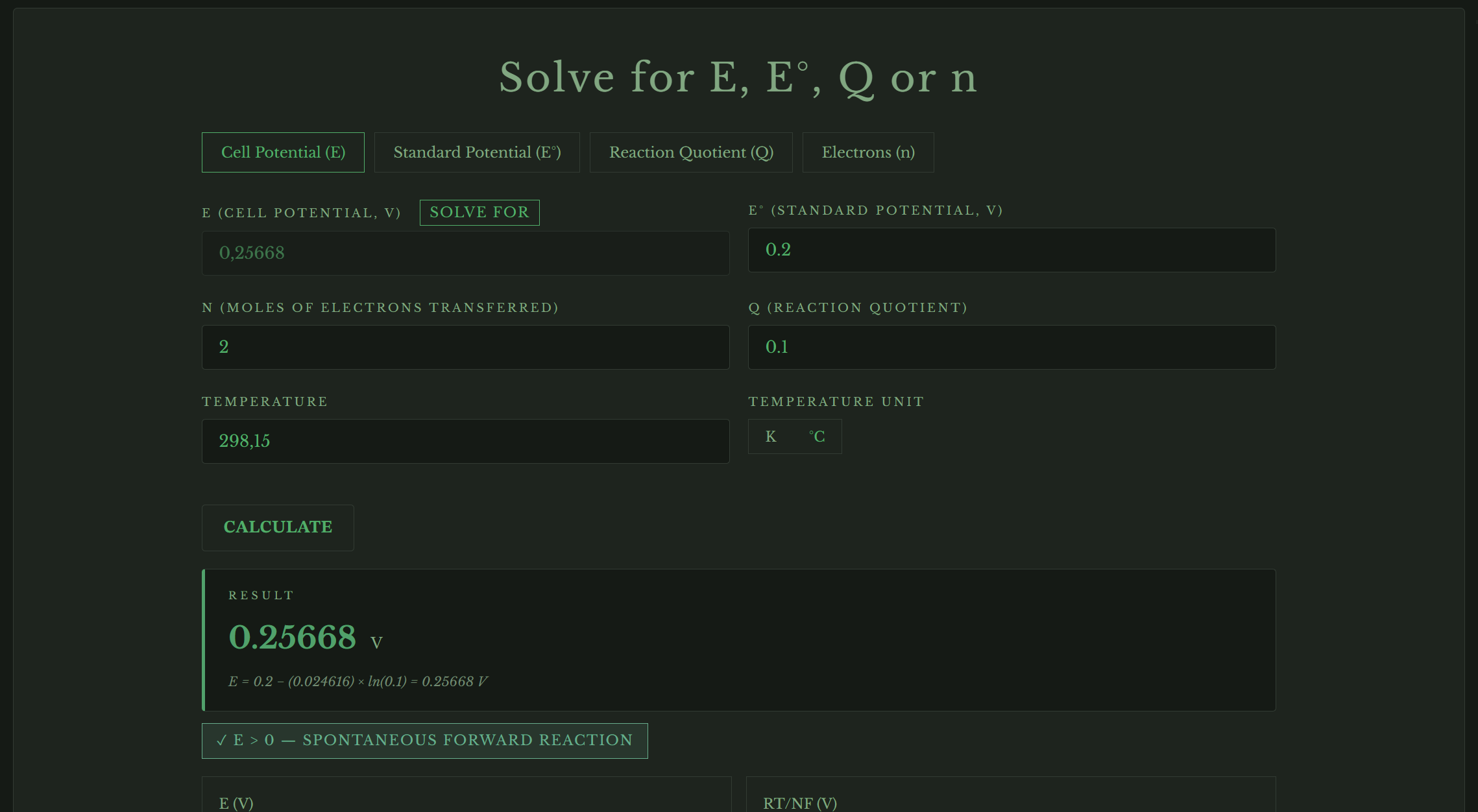
Nernst Equation Calculator
Calculate electrochemical cell potential under non-standard conditions using the Nernst equation.
Solve for cell potential E, standard potential E°, reaction quotient Q, or number of electrons transferred. Interconvert equilibrium constant K and standard cell potential E°.
Ideal for electrochemists and battery or corrosion analysis.
Go to tool →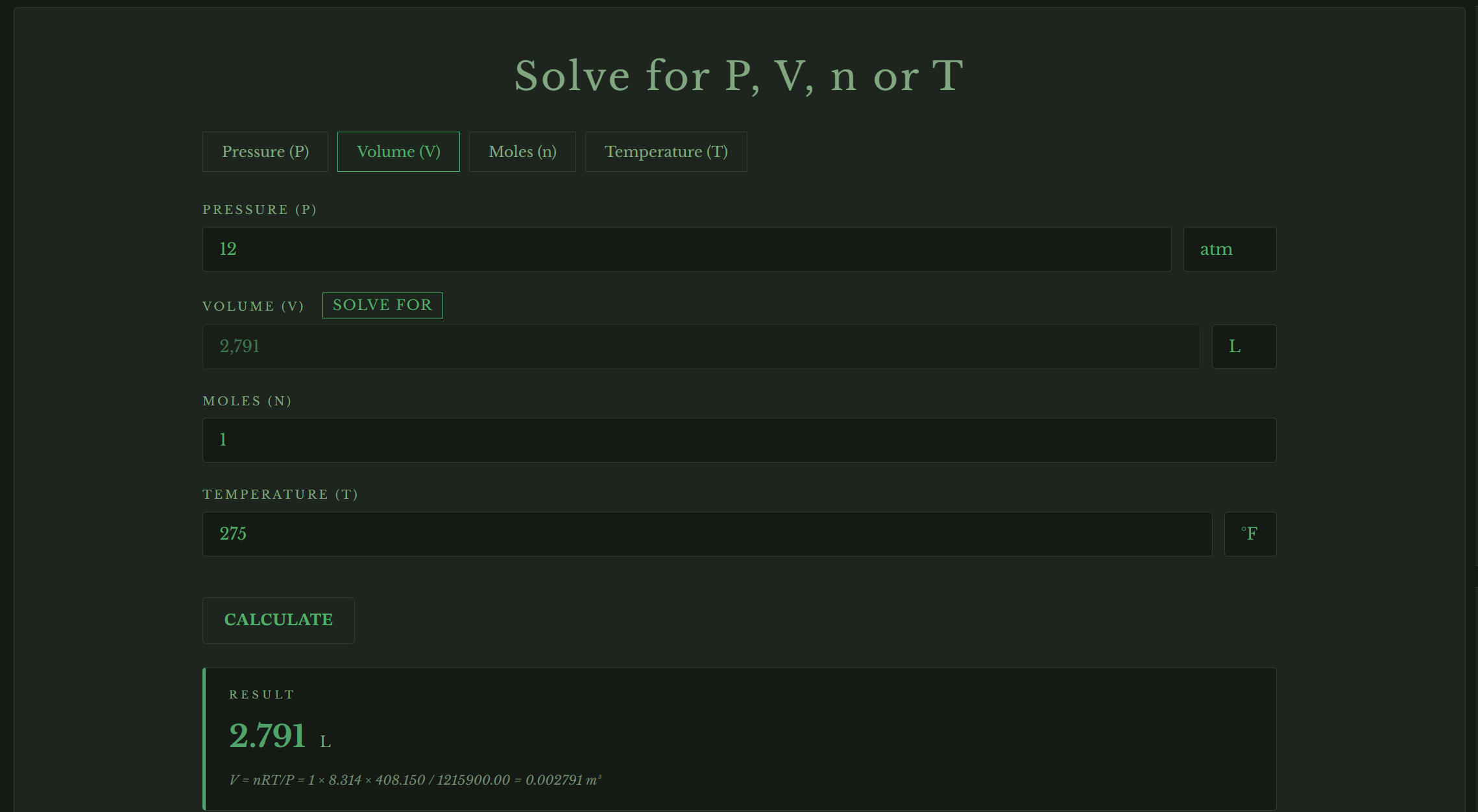
Ideal Gas Law Calculator
Solve PV = nRT for any unknown, pressure, volume, moles, or temperature, with flexible unit selection across Pa, atm, bar, mmHg, L, m³, K, °C and much more.
Ideal for general chemistry, physical chemistry, and engineering thermodynamics problems involving gases under ideal conditions.
Go to tool →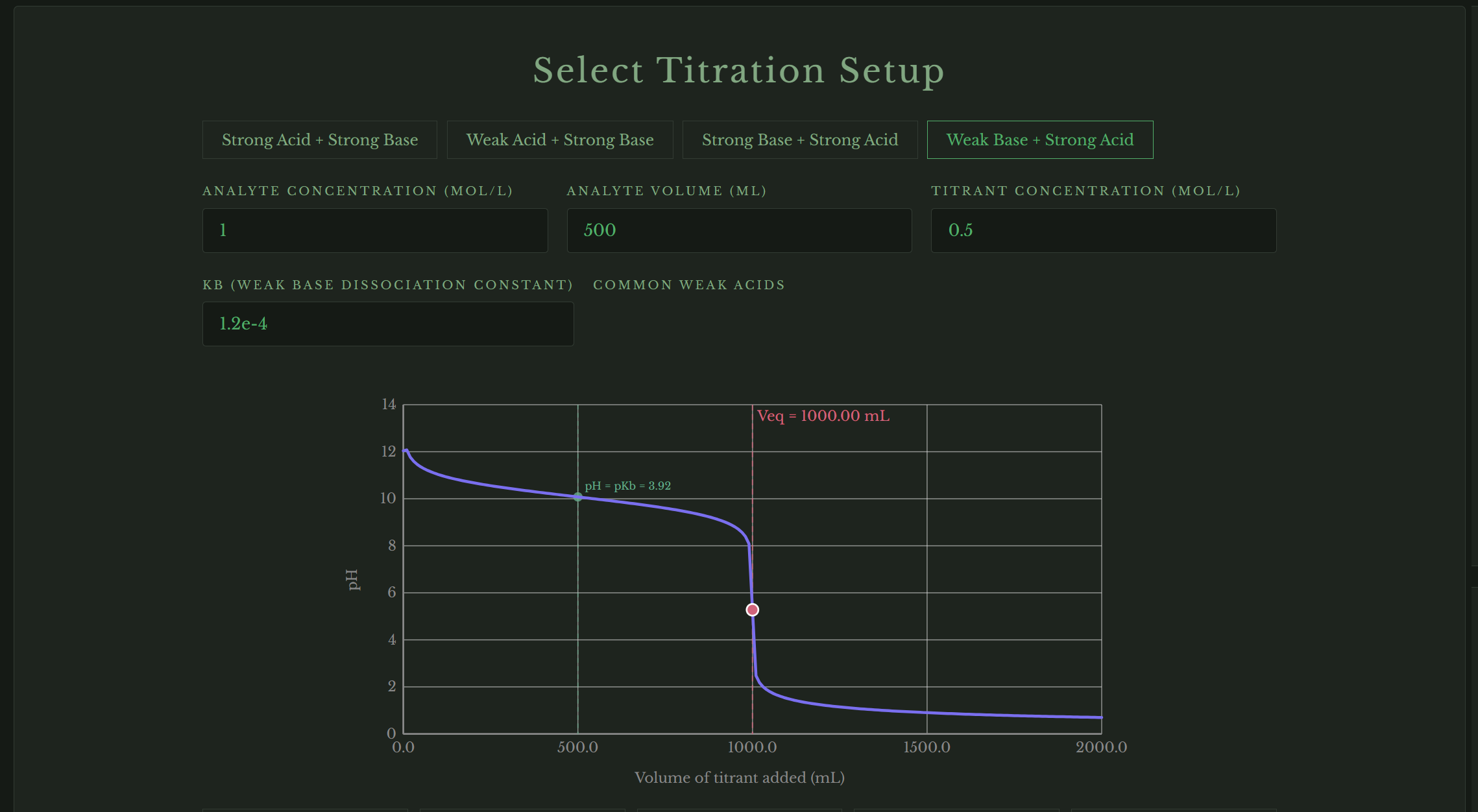
Titration Curve Visualizer
Plot and analyze titration curves for strong acid–strong base, weak acid–strong base, strong base–strong acid, and weak base-strong acid titrations.
Automatically calculates and marks the equivalence point, and provides a graph showing pH against volume of titrant added.
An essential tool for analytical chemistry and anyone studying volumetric analysis and acid-base equilibria.
Go to tool →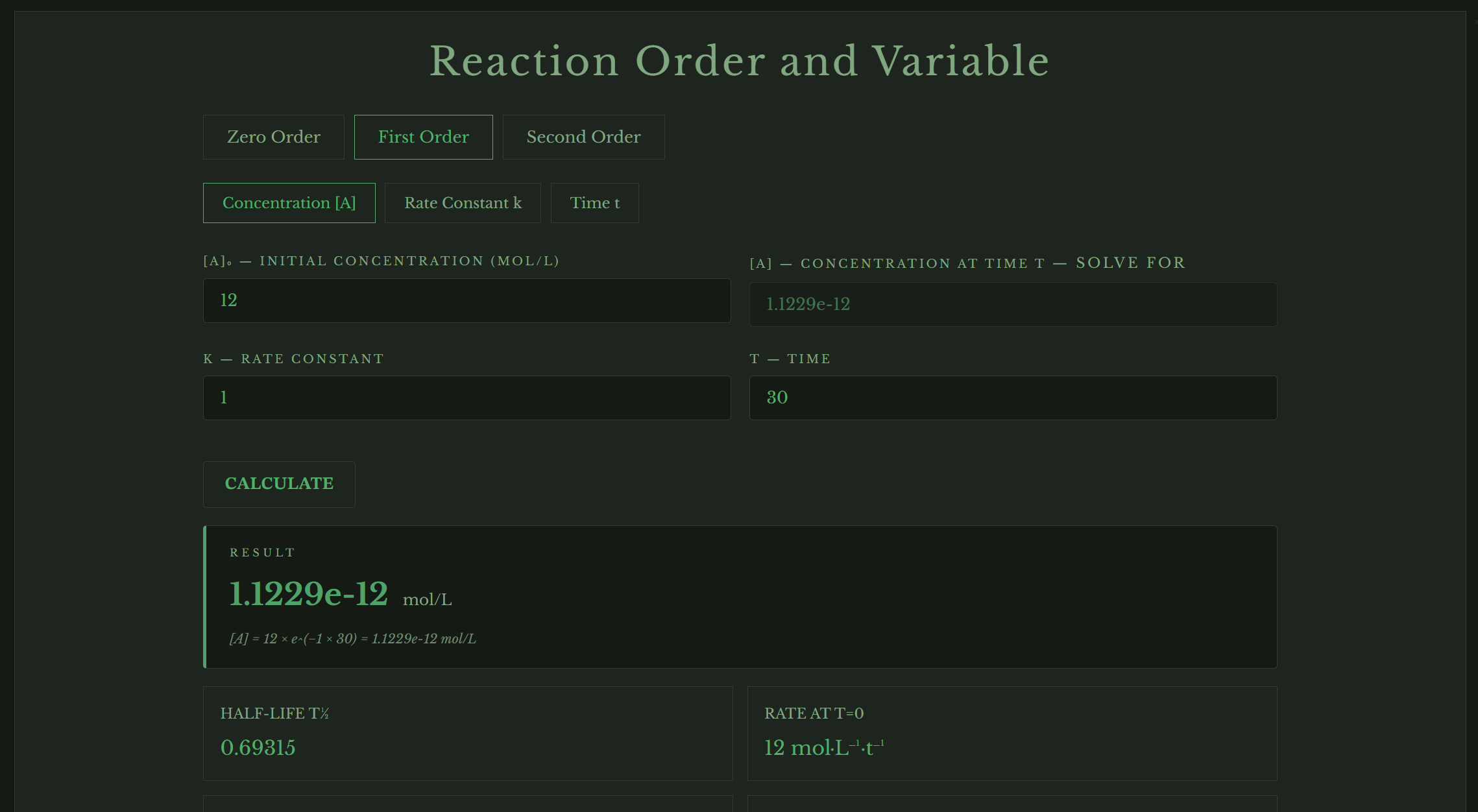
Rate Law Calculator
Solve integrated rate law equations for 0th, 1st, and 2nd order reactions.
Calculate reactant concentration at any time, find the rate constant k from experimental data, or determine the time required to reach a given concentration.
Includes a reference table with all important formulae for each of the reaction orders.
Go to tool →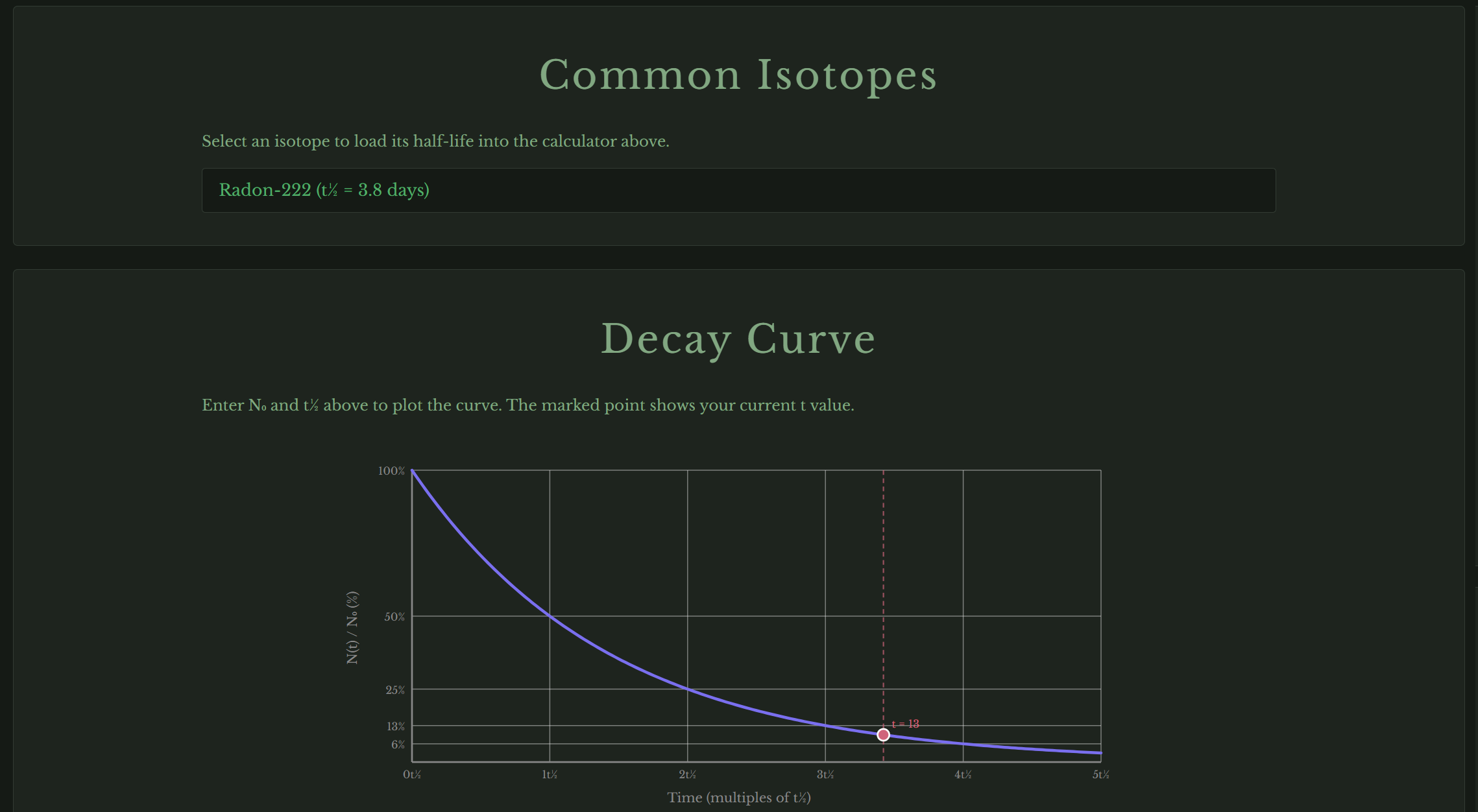
Half-Life Calculator
Calculate radioactive decay parameters including half-life, remaining quantity, time elapsed or initial quantity of a radioisotope.
Supports all radioactive isotope, with a dropdown selection of the most common, and any time and mass units.
Useful for nuclear chemistry, radiometric dating, medical physics, and radiation safety calculations.
Go to tool →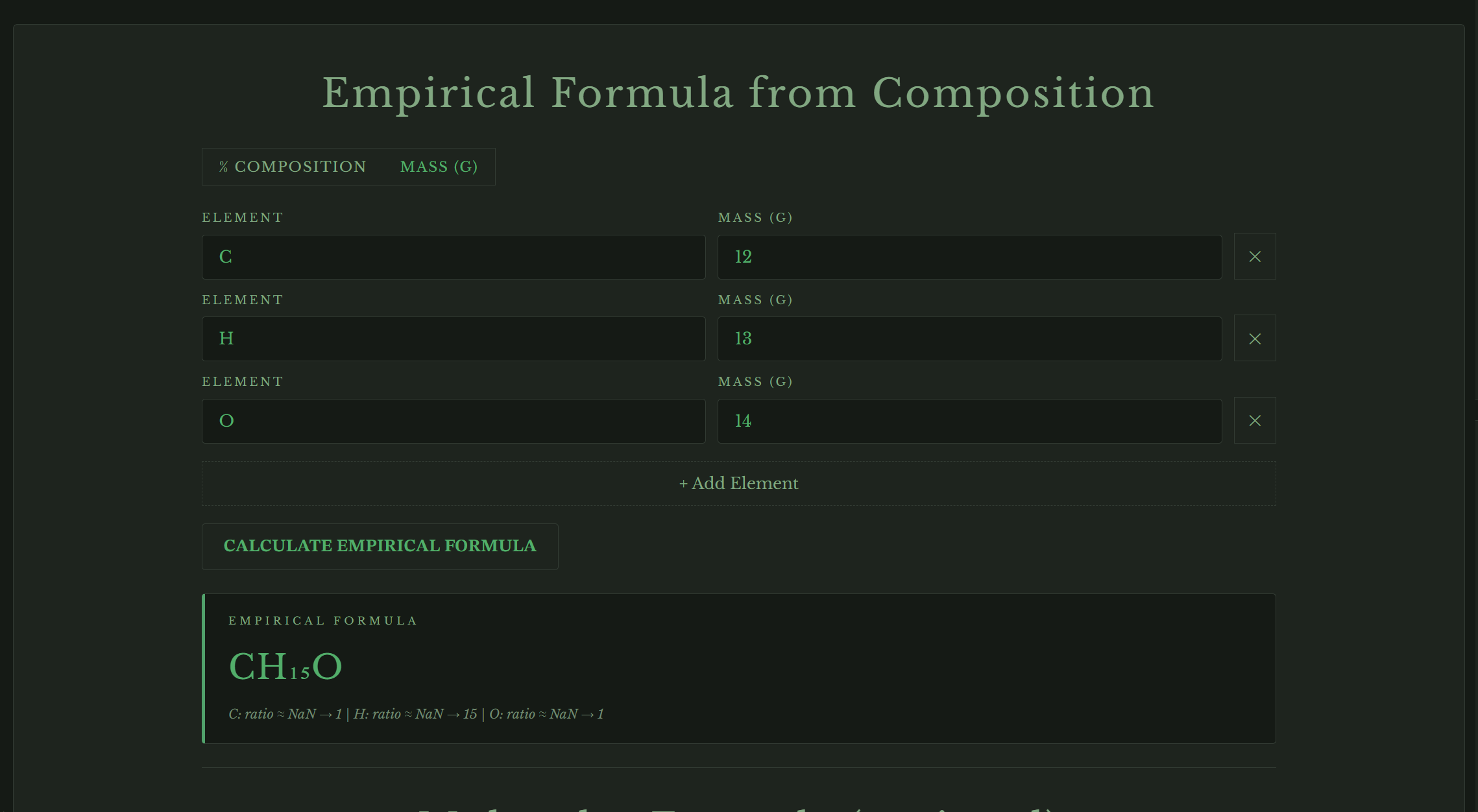
Empirical Formula Calculator
Determine the empirical formula and molecular formula of a compound from elemental percentage composition or raw mass data.
Enter the percentage of each element present and the tool reduces the ratios to the simplest whole-number formula. Also supports molecular formula determinations when provided with molar masses.
Go to tool →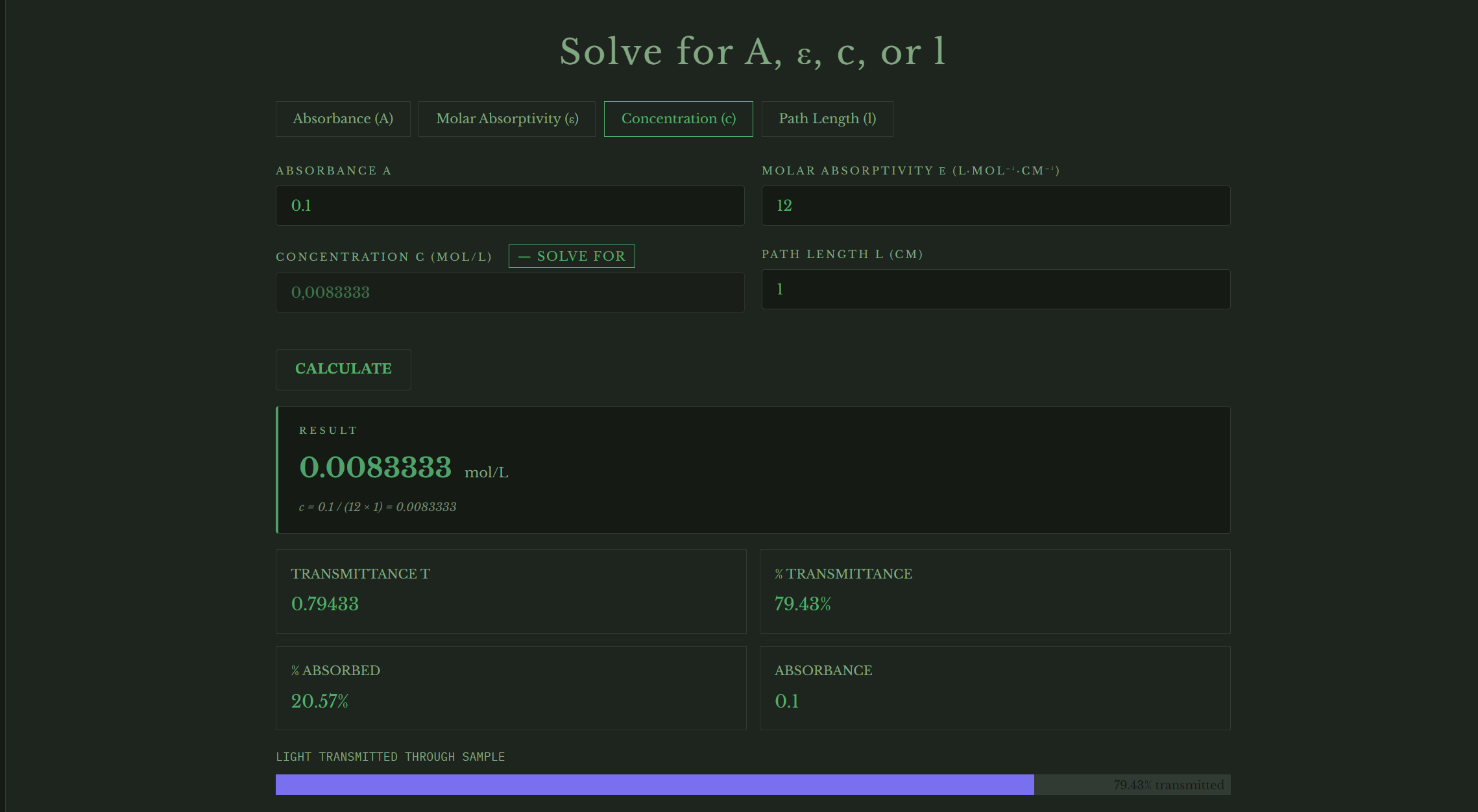
Beer-Lambert Calculator
Solve the Beer-Lambert law (A = εlc) for absorbance, molar absorptivity, concentration, or path length in UV-Vis spectroscopy.
Visualize the amount of light passing through a sample, and interconvert absorbance, transmittance and % transmittance.
Used in analytical chemistry, biochemistry, and materials science for spectrophotometric analyses.
Go to tool →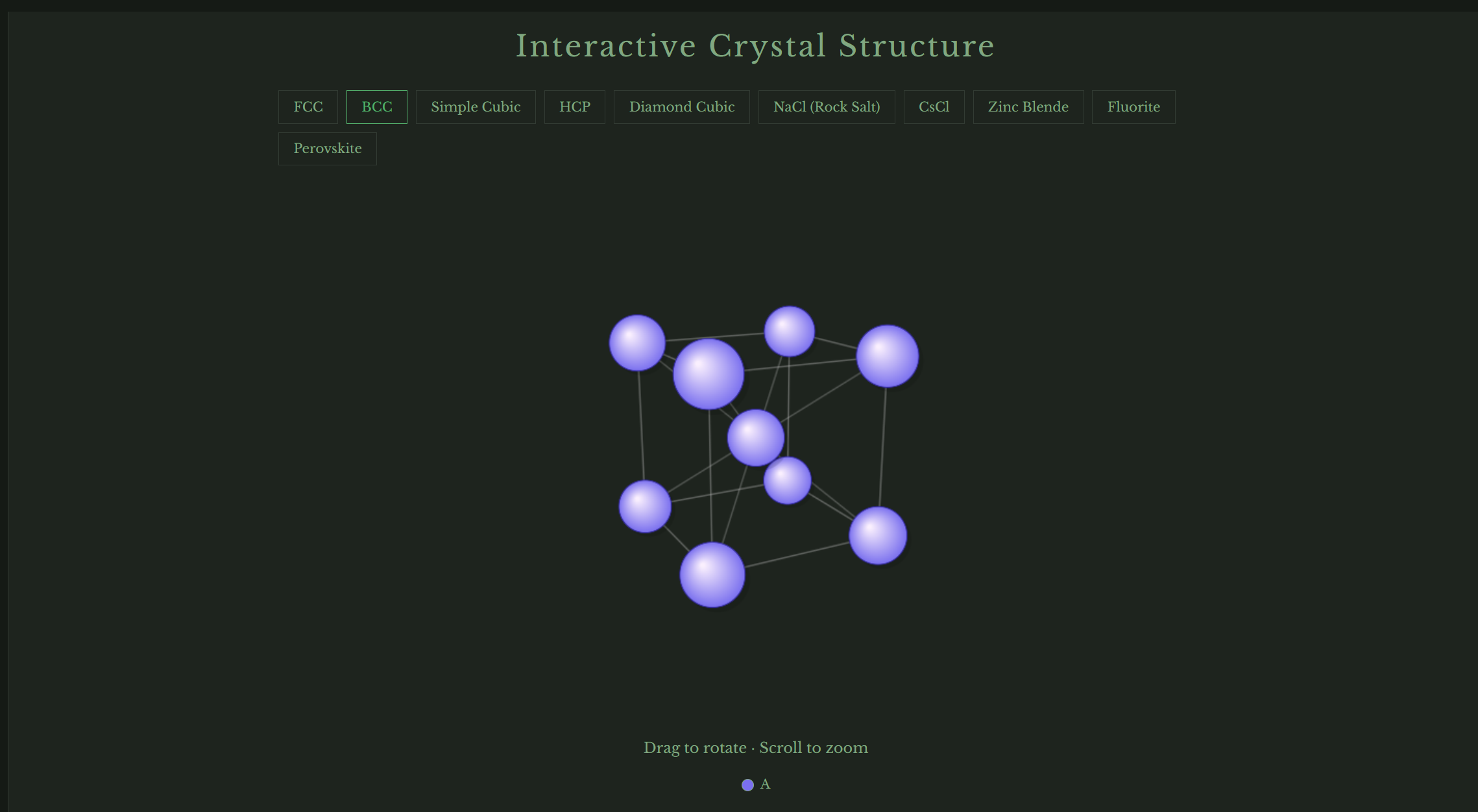
Crystal Structure Viewer
Visualize and interact with 3D models of common crystal structures including body-centred cubic (BCC), face-centred cubic (FCC), simple cubic, diamond cubic, hexagonal close-packed (HCP), and more.
Rotate, zoom, and explore atomic packing arrangements.
Ideal for materials scientists, solid-state chemists, and condensed matter physicists.
Go to tool →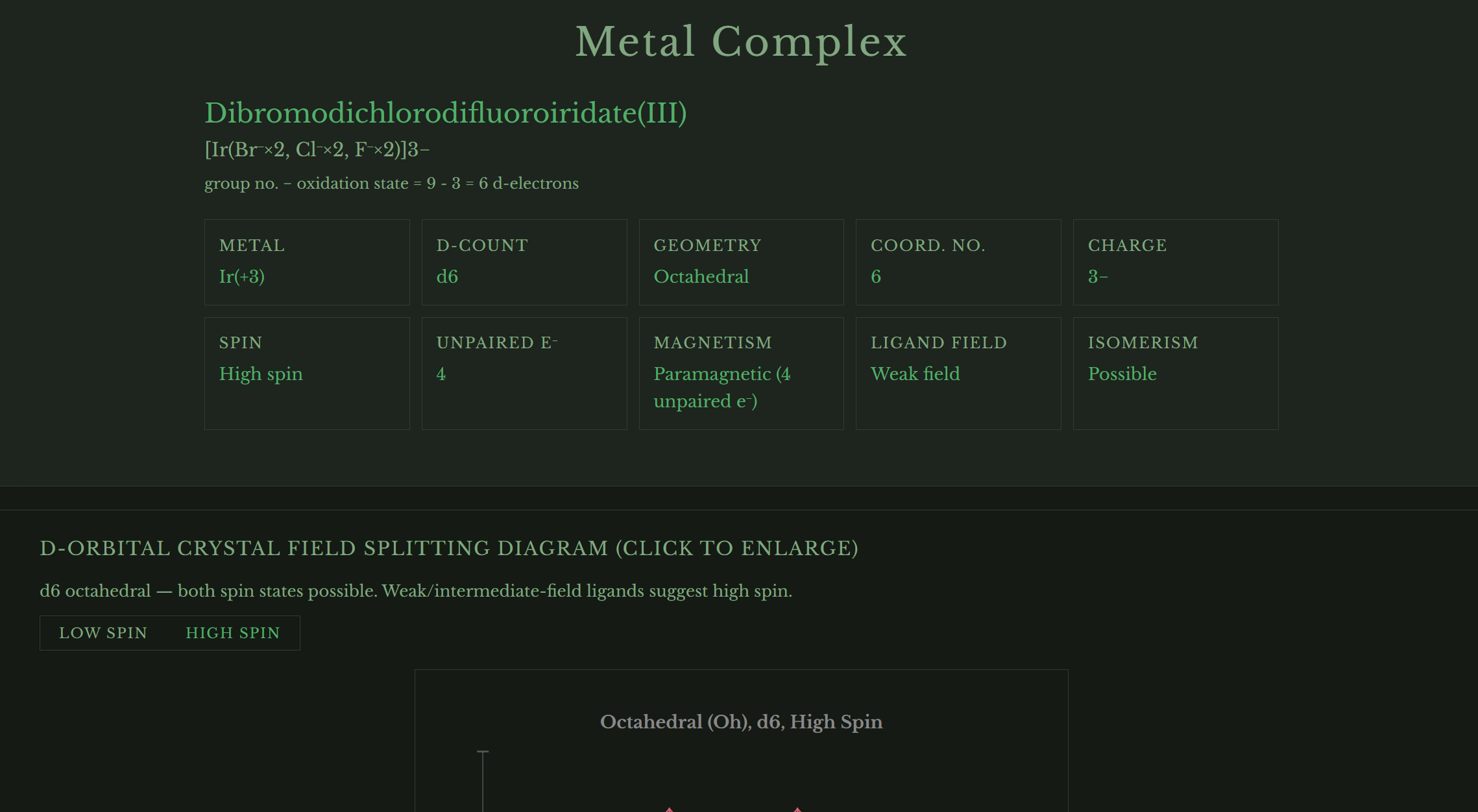
Metal Complex Builder
Build coordination complexes interactively by selecting a transition metal, oxidation state, geometry, and ligands.
Automatically generates the IUPAC name and draws the crystal field d-orbital splitting diagram for octahedral, tetrahedral, and square planar geometries.
Essential for inorganic chemists studying coordination compounds and crystal field theory.
Go to tool →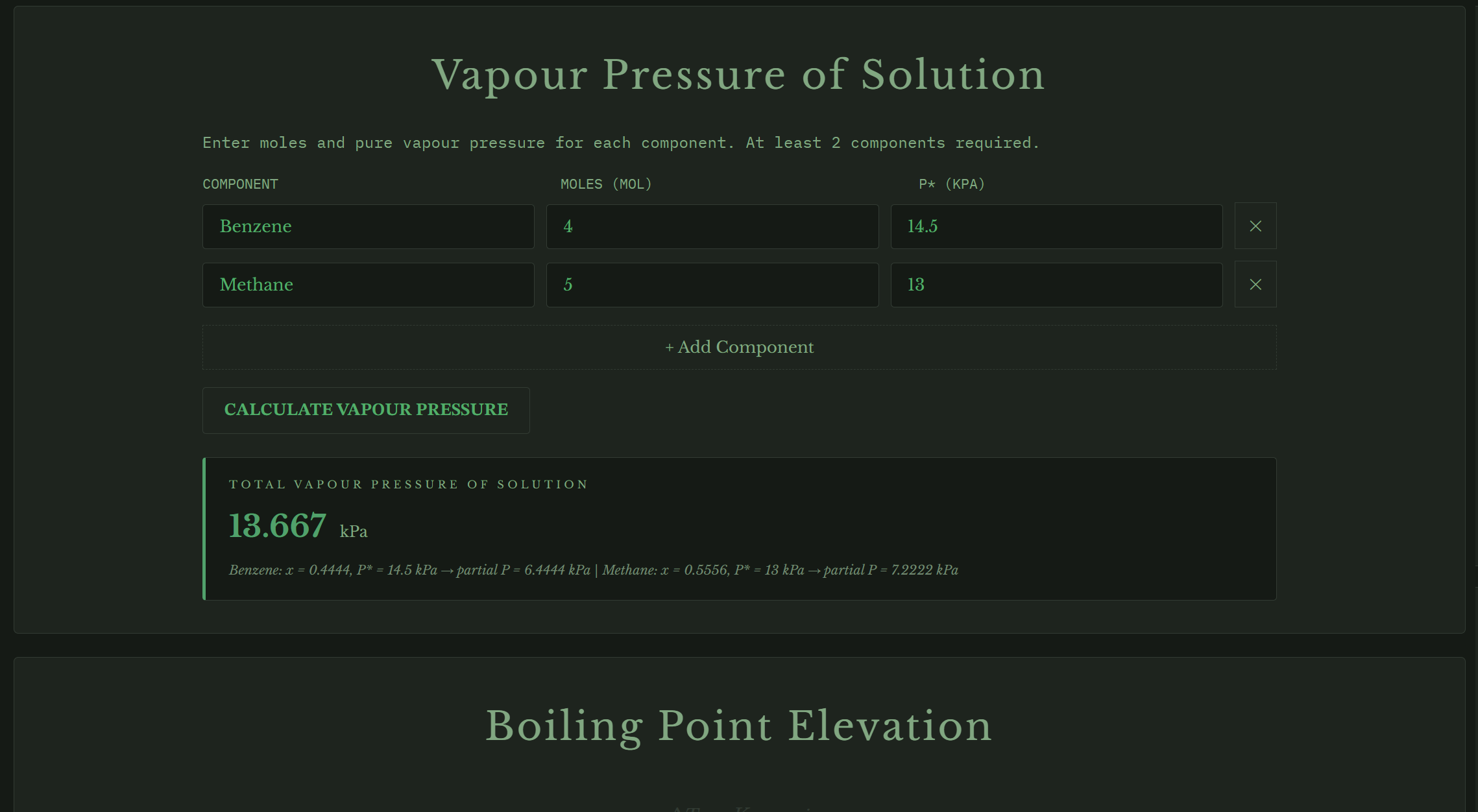
Raoult's Law Calculator
Calculate the vapour pressure of ideal liquid mixtures using Raoult's Law, and solve for boiling point elevation and freezing point depression using colligative property equations.
Enter component mole fractions and pure vapour pressures to find total and partial pressures.
Widely used in physical chemistry and chemical engineering for mixture and solution thermodynamics.
Go to tool →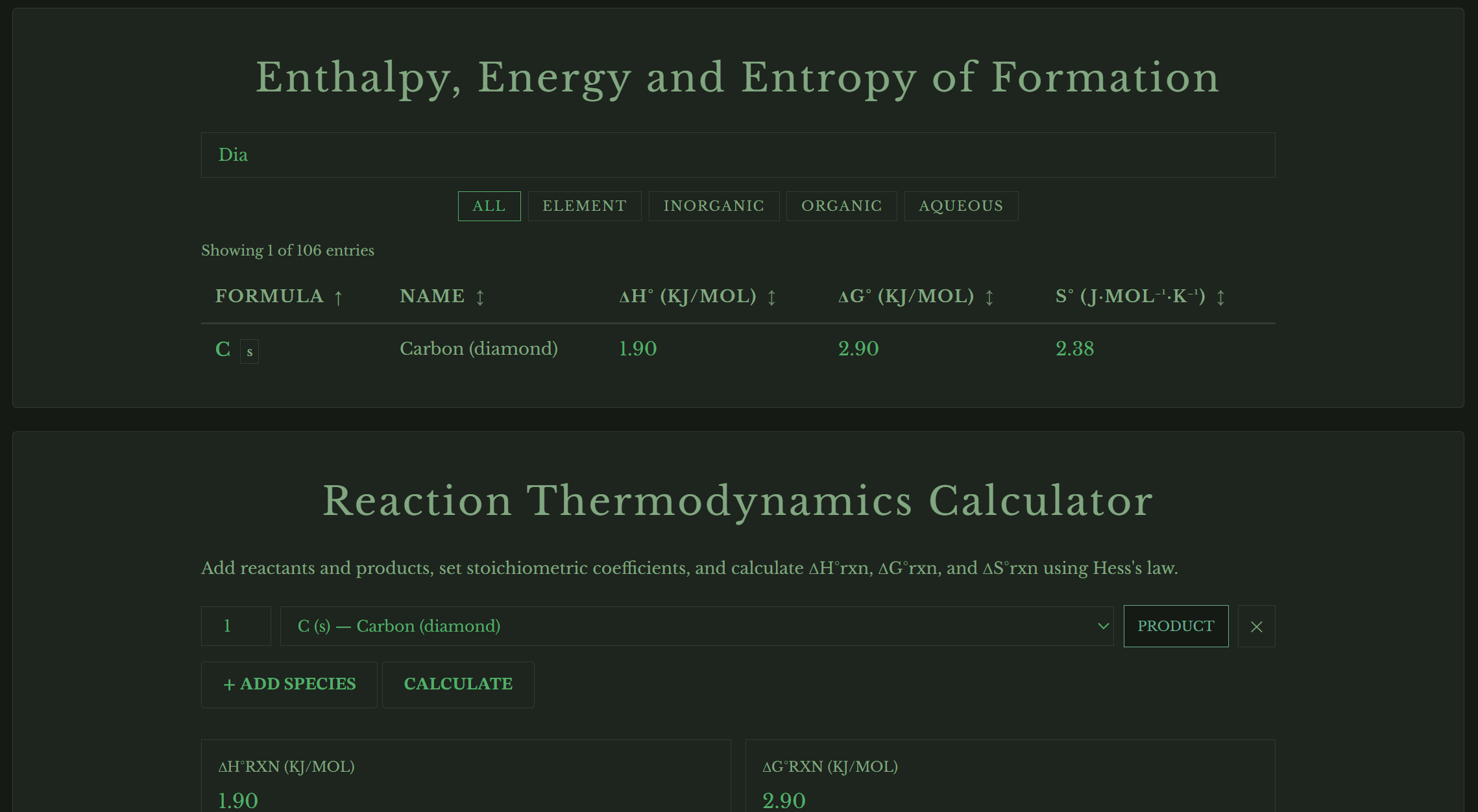
Thermodynamic Data Table
Access standard enthalpy of formation ΔHf°, Gibbs free energy of formation ΔGf°, and standard molar entropy S° data for over 100 common chemical substances.
Searchable and filterable by category, with information about compound formulae, names and phases
An essential reference tool for thermodynamics problems and Hess' Law calculations.
Go to tool →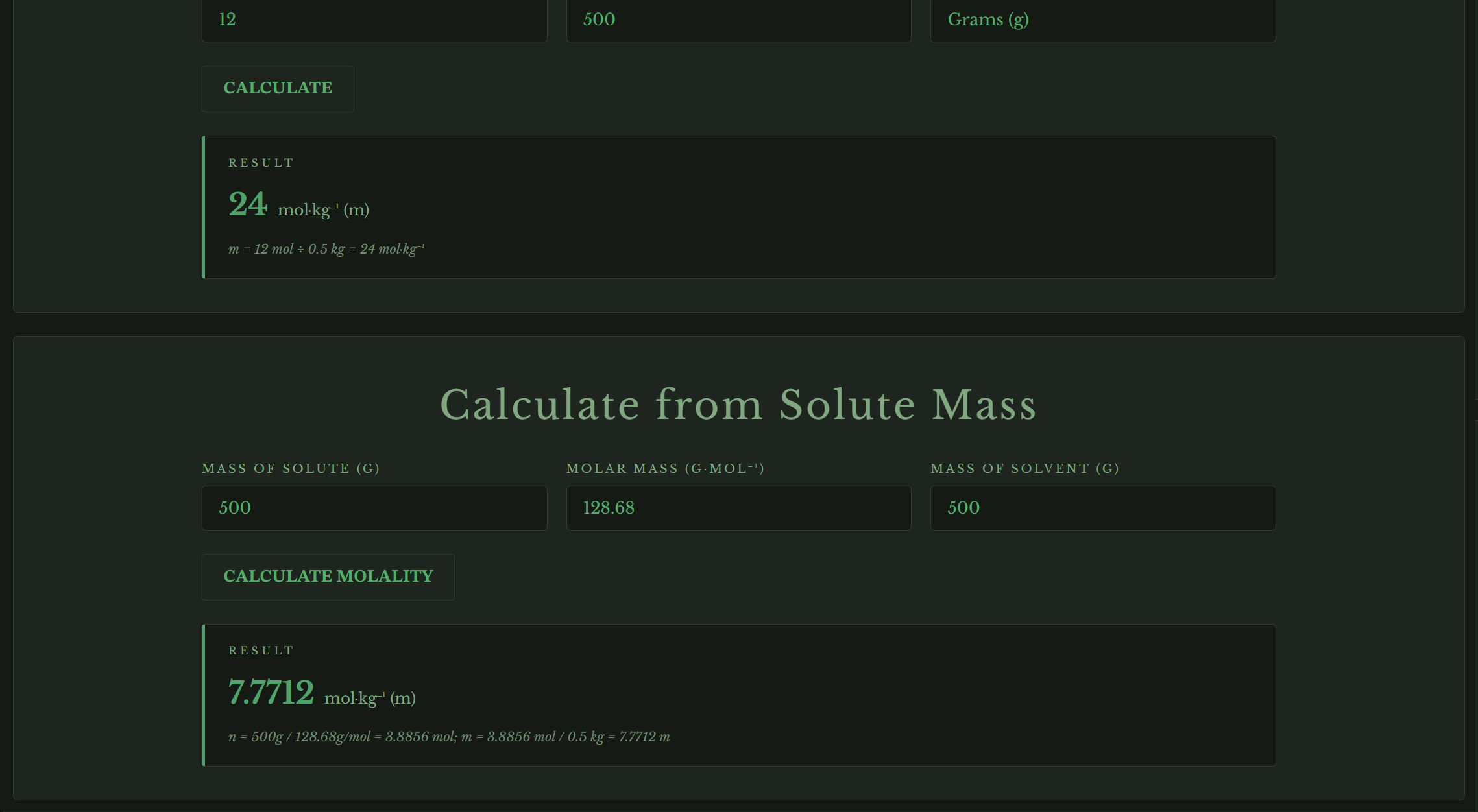
Molality Calculator
Calculate molality (mol/kg) of a solution from solute moles or mass, and solvent mass.
Molality is independent of temperature, making it the preferred concentration unit for colligative property calculations including boiling point elevation, freezing point depression, and osmotic pressure. Supports flexible input units for mass values.
Go to tool →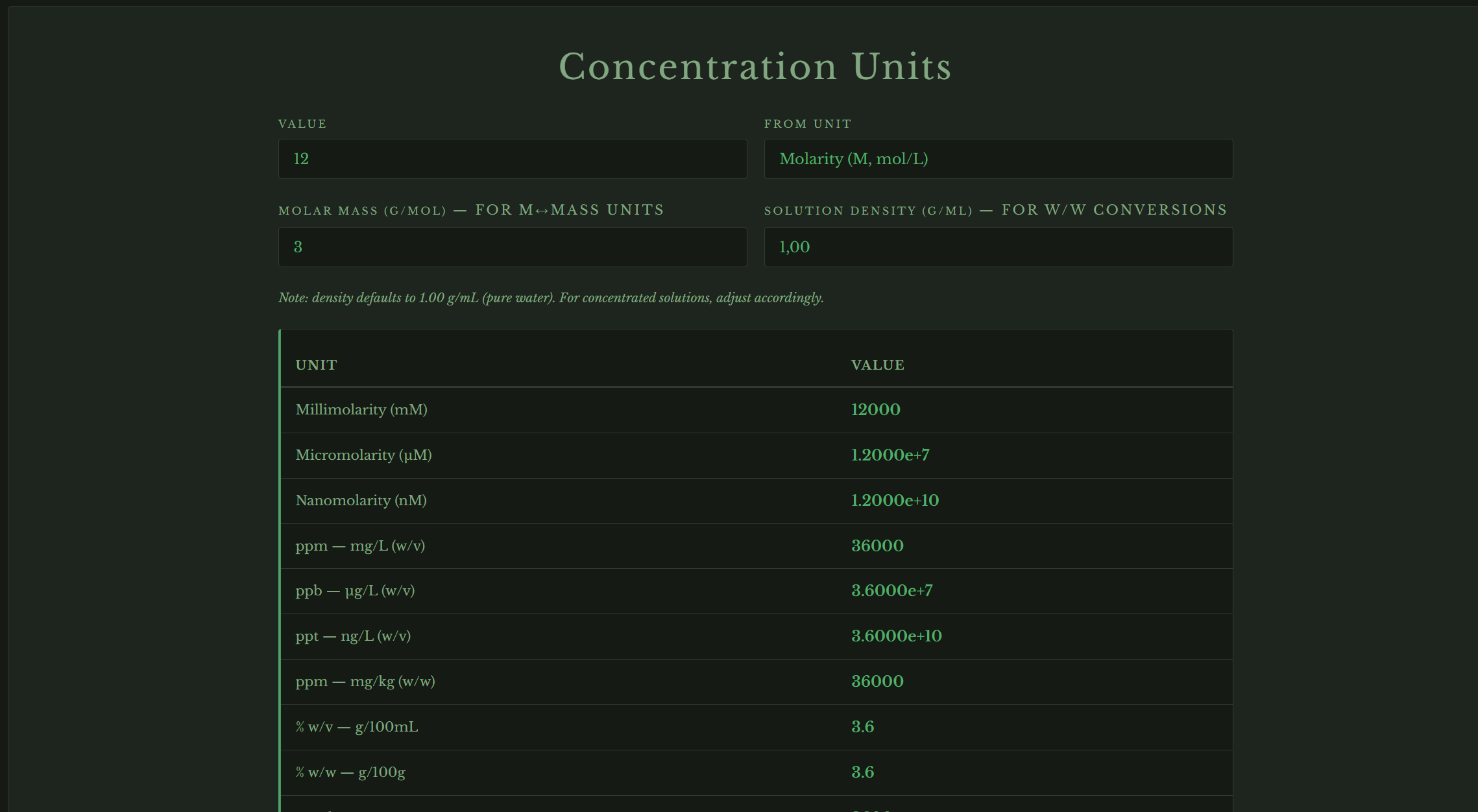
Concentration Converter
Instantly interconvert between molarity (mol/L), mass percent (% w/w and % w/v), ppm, ppb, mg/dL, g/L, and more.
Enter a concentration in any unit and get the equivalent values across all common units simultaneously.
Useful for analytical chemistry, clinical biochemistry, environmental science, and laboratory work.
Go to tool →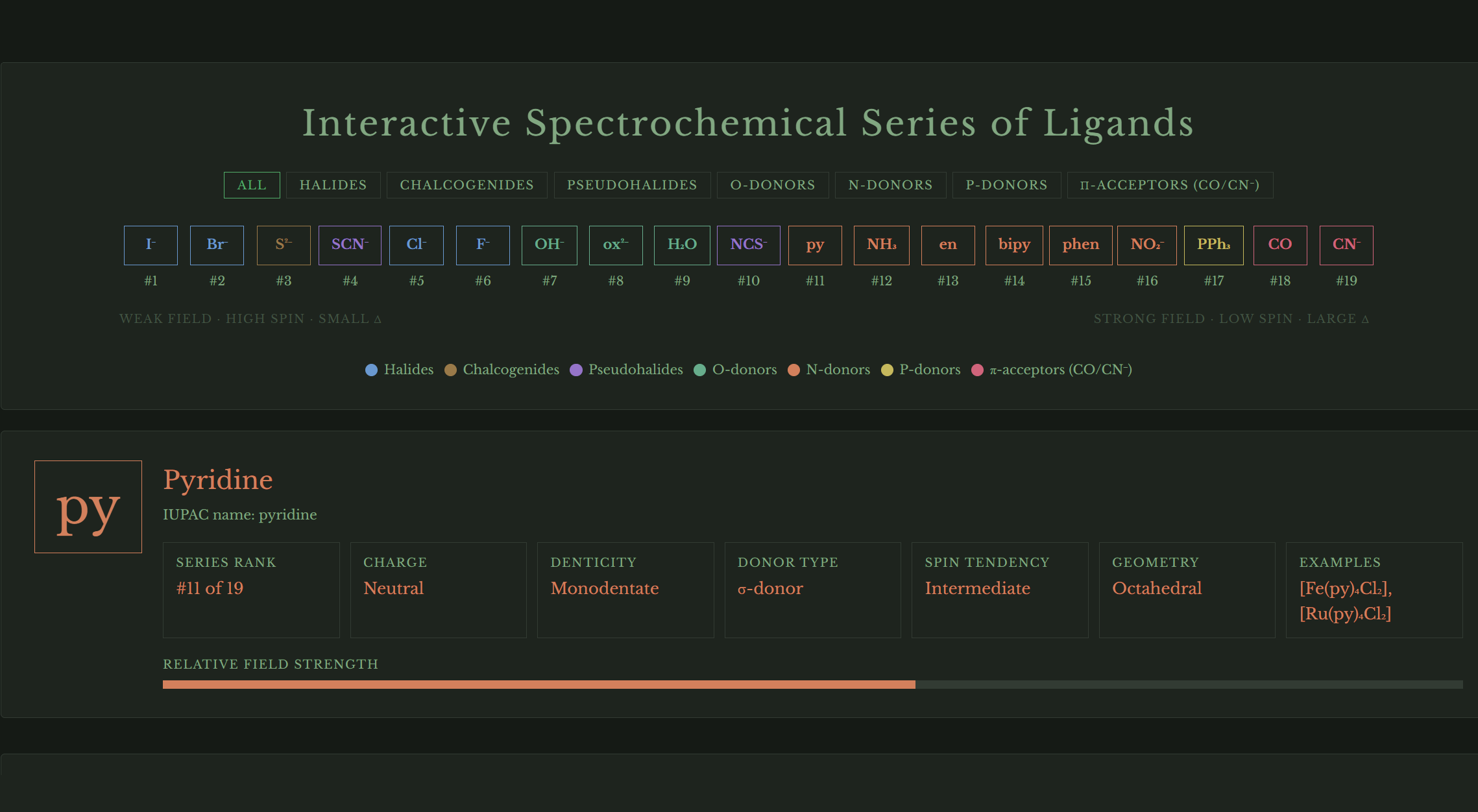
Spectrochemical Series
Explore the spectrochemical series of ligands ranked by crystal field splitting strength, from weak-field ligands like I⁻ to strong-field ligands like CN⁻.
Click any ligand to view its IUPAC name, charge, denticity, donor type, relative field strength and more.
An interactive reference for inorganic chemists and anyone studying crystal field theory, d-orbital splitting, and coordination complexes.
Go to tool →